

Endocrine Disruptors in Drinking Water: A Homeowner’s Guide
Endocrine Disruptors in Drinking Water: A Homeowner’s Guide
Your hormones regulate nearly every essential function in your body, from growth and metabolism to mood, stress response and reproduction. Hormones are very sensitive chemical messengers, meaning even small changes can have significant and lasting consequences.
This is why many homeowners are paying close attention to endocrine-disrupting chemicals (EDCs), which mimic, block and interfere with your body’s hormones. We are exposed to EDCs throughout daily life — in water, food packaging, pesticides, household products and even the air we breathe.
Removing EDCs from your water is a crucial step you can take to protect your family’s health and wellness.
What Are Endocrine Disruptors?
Endocrine disruptors are natural or man-made chemicals that interfere with the body’s endocrine (hormone) system. Of the nearly 85,000 human-made chemicals on Earth, more than 1,000 can negatively impact your body’s hormones.
Hormones control critical processes in your body, including:
- Growth and development
- Metabolism
- Thyroid function
- Reproductive health
- Mood and stress regulation
- Cardiovascular function
The Risks of Low, Chronic Exposure
The endocrine system runs on tiny chemical signals, where a network of ductless glands releases hormones directly into the bloodstream to regulate functions like metabolism, appetite and heart rate.
The National Institute of Environmental Health Sciences (NIEHS) explains that “low doses of endocrine-disrupting chemicals may be unsafe” because small hormone changes can have outsized effects over time — especially during pregnancy, infancy and puberty.
For example, endocrine disruption has been linked with reproductive issues, hormone-related cancers, heart and breathing problems, obesity, diabetes and thyroid disorders.
Research is still evolving, and drinking water regulations don’t cover every type of contaminant, making water testing and treatment important for protecting your health.
How Do Endocrine Disruptors Get Into Drinking Water?
Endocrine-disrupting contaminants can enter water supplies through:
- Industrial discharge and spills
- Agricultural runoff, with pesticides and herbicides moving into surface water and groundwater
- Landfill leachate, where chemicals leach into groundwater
- Aging infrastructure and plumbing
- Municipal water disinfection processes, where byproducts form from chlorine/chloramine interaction with organic matter
Both city water and private wells can contain EDCs, though the types and levels of contamination may differ.

Is This Only a Drinking Water Issue, or Does Skin Contact Matter?
When it comes to water, exposure to endocrine-disrupting chemicals can happen through:
- Ingestion – drinking, cooking, ice
- Skin contact – bathing, dishwashing, handwashing
- Inhalation – such as breathing chemicals which volatilize into the air during showering
Drinking water is the main concern and pathway in most cases, though for volatile and semi-volatile compounds, the hot water and aeration from showering can put those chemicals into the air.
Skin contact risk depends on the contaminant, but for PFAS, most metals and many pesticides in water, dermal absorption is typically much lower than ingestion.
Types of Endocrine-Disrupting Contaminants in Water
There are over 1,000 known man-made chemicals that can interfere with hormones and cause broader consequences for your health. Water is a common, but not the only exposure source and is a meaningful one especially over time.
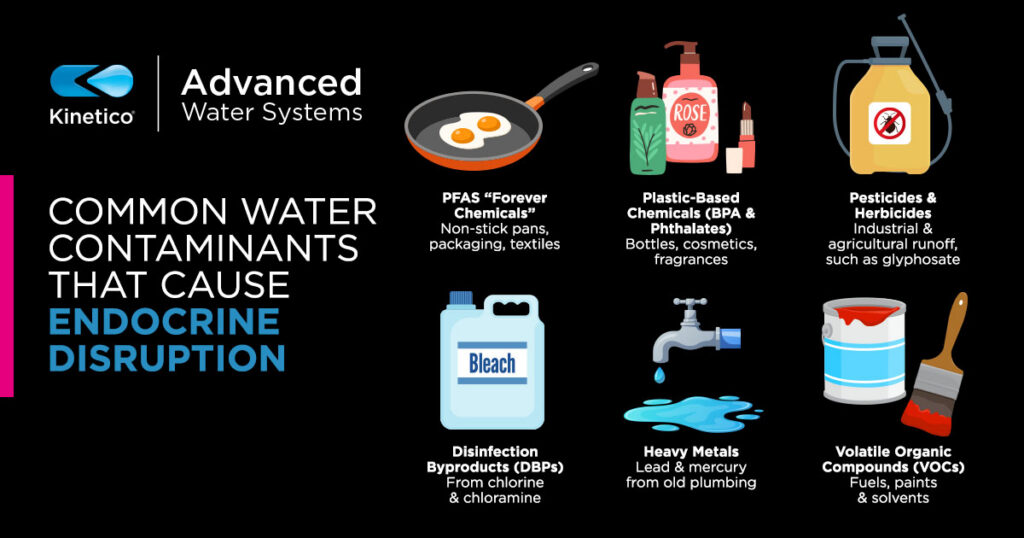
1. PFAS “Forever Chemicals”
Per- and polyfluoroalkyl substances (PFAS) are a large family of chemicals used in industrial applications and consumer products, including:
- Non-stick cookware
- Food packaging
- Textiles
- Firefighting foams
PFAS have been associated with hormone disruption, thyroid problems and certain cancers. Because they don’t easily break down, they often accumulate in water supplies and your body.
2. Plastic-Associated Chemicals (BPA and Phthalates)
Plastic-associated chemicals and plasticizers such as BPA and DEHP are common in food packaging, cosmetics and fragrances. They also can make their way into drinking water.
- BPA (Bisphenol A) – Used in polycarbonate plastics, such as large water jugs, and epoxy resins coating water supply lines.
- Phthalates – Can leach from plastic bottles into the water, especially when exposed to heat.
- Polyethylene terephthalate (PET) – PET bottled water makes up 79% of global bottled water and can release harmful EDCs into the water.
3. Pesticides & Herbicides
Certain pesticides and herbicides can cause hormonal disruption. Pesticides commonly found in drinking water include atrazine, glyphosate and 2,4-D.
Private wells and homes near golf courses may be more susceptible to pesticide contamination.
4. Disinfection Byproducts (DBPs)
Municipal water utilities use chlorine and chloramine to disinfect water. When these chemicals react with organic matter in the water, they can form disinfection byproducts (DBPs), including:
- Total trihalomethanes (TTHMs)
- Haloacetic acids (HAA5)
These are linked with hormone-related and long-term health effects, and may be released when showering.
5. Volatile Organic Compounds (VOCs)
VOCs are a broad category of chemicals including fuels, degreasers, dyes and industrial solvents. Many are regulated due to cancer and organ toxicity risks:
- Benzene
- Toluene
- Trichloroethylene
- Formaldehyde
6. Heavy Metals
Certain heavy metals, such as lead and mercury, can cause endocrine disruption and are linked with developmental and neurological impacts.
Old lead-containing pipes are not uncommon in homes throughout the U.S., making water testing, treatment and plumbing updates essential.

Municipal vs. Well Water: Is One Safer?
Municipal water is generally safe to drink, unless your utility has issued a local advisory of contamination, or your home plumbing introduces risks like lead.
Private well water won’t contain the disinfection chemicals of city water, but is more susceptible to agricultural runoff and localized pollution as it receives no treatment unless installed by the homeowner.
However, safe doesn’t always mean healthy — EPA regulations for drinking water are designed to protect public health, not ensure optimal long-term health.
Municipal and Community Well Water
- Treated and monitored to meet EPA standards
- Can contain disinfectant residuals and byproducts, formed when chlorine/chloramine interacts with organic compounds
- Can contain PFAS and other emerging contaminants
Private Well Water
- Not regulated or monitored by the EPA
- No disinfection byproducts or chlorine/chloramine, unless introduced by the homeowner
- Vulnerable to agricultural runoff, pesticides, VOCs, heavy metals and bacteria
- Requires homeowner-led testing
No matter the source, the only way to know what’s actually in your water is through professional water testing.
A Closer Look: EPA Regulations for Endocrine Disruptors
READ THE BLOGHow to Reduce Exposure to Endocrine Disruptors in Water
Because endocrine-disrupting chemicals vary widely in structure and behavior, treatment should be tailored to remove the identified contaminants.
Professional Water Testing
In-home water analysis helps measure fundamentals including hardness, pH, iron, sediment, chlorine/chloramine and more. Detecting endocrine disruptors (PFAS, many pesticides, VOCs) usually requires certified laboratory testing with very low detection limits, down to parts per billion or trillion.
At Kinetico, we can advise if laboratory testing is necessary for your home, based on a free water test and consultation, as well as plumbing age, your home’s proximity to industrial sites, farms, golf courses and other factors.
Note that at-home water tests are not capable of measuring endocrine disruptors unless you send them into a lab.

Custom Treatment Based on Your Water Quality
The best and most cost-effective choice for clean water for your whole home will be to install professional water treatment, based on the results and interpretation of your water test.
Most refrigerator and pitcher-style water filters aren’t designed to remove endocrine disruptors like PFAS, pesticides and DBPs in water. Specialized pitcher filters can target some EDCs, though these come with high recurring costs for filter replacements, create plastic waste and only work for your drinking water.
Reverse Osmosis Purification: Targets many dissolved contaminants in drinking and cooking water. The K5 Drinking Water Station® is one of the most certified RO systems in the world, including NSF/ANSI 42, 53 and 58 (for PFOS/PFOA and lead). The K5 can remove up to 95 to 99.999% of heavy metals, pharmaceuticals, VOCs, silica and both long- and short-chain forever chemicals.
Whole-Home Filtration: Significantly reduce chlorine, chloramine and some VOCs and DBPs with a Kinetico whole-home granular activated carbon filtration system, improving water for drinking, cooking, bathing and everyday use.
Specialty Systems: Unique water problems and contaminant profiles can require a more specialized approach, such as reducing arsenic or uranium.
Other Ways to Reduce EDC Exposure
Hormone-disrupting chemicals exist throughout our environment and daily life. The NIEHS notes that exposure can occur via air, water, skin absorption and diet.
In addition to water treatment:
- Look for cosmetics, personal care products and sunscreens without PFAS and other EDCs, such as parabens or phthalates.
- Use indoor air purifiers to reduce pollutants such as VOCs from cleaning products.
- Limit single-use plastics at home by choosing glass, ceramics or stainless steel when possible, or BPA-free plastics.
- Avoid foods or supplements with a Proposition 65 warning, which indicates chemical exposure linked with cancers, reproductive harm and birth defects.
- Avoid microwaving plastics, as this leaches chemicals into your food, including millions of microplastics.
Schedule a Free Water Analysis
Worried about endocrine disruptors and other harmful chemicals that could be in your water?
Schedule a free water analysis with Kinetico Advanced Water Systems to better understand your home’s water, and explore treatment options tailored to your needs and budget.